

If you’re anything like me, you believe that anything done without passion is rarely sustainable—and almost never legitimate in the long run. Whether it’s a business, a career, or even how we show up as parents or employees, passion is the fuel that gives our actions purpose and longevity.
Some passions are innate; others are shaped by our environment, exposure, and lived experiences. Real estate, for many of us, falls into the latter—developed through observation, opportunity, and the undeniable impact it has on wealth creation and economic growth.
Today, we dig deeper into the passion behind the real estate sector in Tanzania. Drawing inspiration from our founding principles, we briefly explore what real estate truly represents and how Tanzania’s landscape differs from that of other countries.
Key Differences
These factors, among many others, have fueled our passion for the sector. Real estate has provided leverage, relatively lower risk, and strong yield potential when approached with focus, discipline, and sound fundamentals.
Beyond returns, real estate offers diversification opportunities across residential, commercial, industrial, hospitality, and mixed-use developments—making it attractive not only to investors but also to professionals seeking long-term career growth within the sector.

-
Land Scarcity and Regulation
In many countries, strict land laws and zoning regulations make land in high-density or prime areas extremely scarce or prohibitively expensive to develop. In contrast, Tanzania still offers accessible development opportunities when approached strategically and compliantly. -
Construction Materials and Labor Costs
In developed markets, construction costs are significantly higher due to the limited availability and high pricing of key materials such as gypsum and aggregates, as well as expensive skilled labor. Tanzania benefits from relatively affordable materials and labor, improving project viability and margins. -
Open and Evolving Mortgage Market
While still developing, Tanzania’s mortgage market continues to open up, gradually improving access to property financing and stimulating both residential and commercial demand. -
Seasonality, Tourism, and Affordability
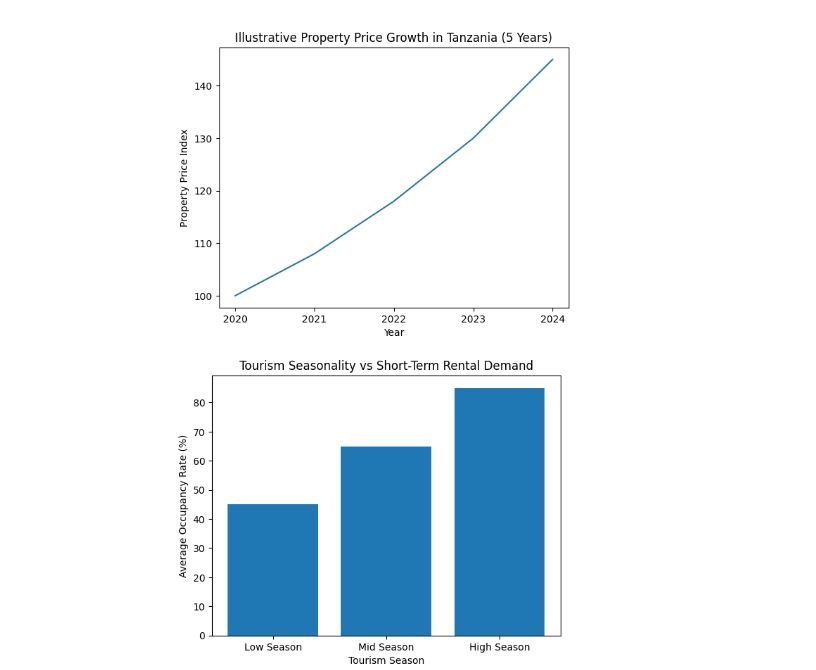
Tanzania’s tourism appeal—combined with its favorable climate and comparatively affordable living costs—creates strong demand for short-term rentals, hospitality assets, and lifestyle properties. -
Low Entry Cost and Flexible Investment Models
The sector allows for multiple entry points, including wholesale real estate strategies, Airbnb investments, joint ventures, and phased developments—making it accessible to both new and seasoned investors.
Why Tanzania
Why Tanzania Is Unique
-
End-to-End Process Automation
Land and property-related processes are increasingly digitized, significantly reducing bureaucracy, fraud, and inefficiencies while improving transparency and investor confidence. -
Steady Property Price Growth
Over the past five years, property prices in Tanzania have demonstrated consistent and stable growth—an encouraging indicator of market resilience and long-term value appreciation. - Country position – Strategical East Africa Entrance / Rift Valley
Sed ultrices placerat metus. Vivamus posuere leo nunc, eget mollis odio posuere nec.
Access to Land
Under the Tanzania Investment Act of 1997 and the Land Act of 1999, occupation of land by non-citizen investors is restricted to lands for investment purposes. Land may be leased for up to 99 years, but the law does not allow individual Tanzanians to sell land to foreigners. There are a number of opportunities for foreigners to lease land, including through TIC, which has designated specific plots of land (a land bank) to be made available to foreign investors.
Foreign investors may also enter into joint ventures with Tanzanians, in which case the Tanzanian provides the use of the land (but retains ownership, i.e., the leasehold). The URT is currently expanding TIC’s land bank, through an established land bank compensation fund, and
modernize its land titling and registration system.
Intellectual Property Rights
The Fair Competition Commission (FCC) is responsive to requests for assistance from private companies and takes action against counterfeiters.
Registration of patents and trademarks is on a first-in-time, first-in-right basis, so companies should consider applying for trademark and patent protection in a quick manner. It is the responsibility of the rights’ holders to register, protect, and enforce their rights where relevant, retaining their own counsel and advisors.
Tanzania is one of the most peaceful and politically stable countries in Africa. Since its independence in 1961, the country has never experienced a civil war or any major internal strife.
Tanzanians continue to live in peace and with a sense of a common national identity without ethnic division. Since independence in 1961 under the leadership of the father of the nation, the late Julius Kambarage Nyerere, Tanzania has witnessed five transfers of leadership through free and fair elections. Since 1992, Presidential terms are limited to two terms (each term of 5 years).
Supportive Investment Infrastructure
The Government has deliberately invested into support real estate investments in Tanzania which includes:-
Three Major Strategic Sea Ports
Dar es Salaam port is the Tanzania principal port with a rated capacity of 14.1 million (MT) dry cargo and 6.0 million (MT) bulk liquid cargo. The Port has a total quay length of about 2,600 metres with eleven deep-water berths. Dar es Salaam port handles about 95% of the Tanzania international trade. The port serves the landlocked countries of Malawi, Zambia, Democratic Republic of Congo, Burundi, Rwanda, Uganda and Zimbabwe. The port is strategically placed to serve as a convenient freight linkage not only to and from East and Central Africa countries but also to middle and Far East, Europe, Australia and America. This boosts the real estate market assisting landlords/real estate investments in
Tanzania Ports Authority is implementing Dar es Salaam Marine Gateways Projects (DMGP) will improve the effectiveness and efficiency by converting the port as world class port with optimized efficiency to accommodate the calling and reception of larger vessels. But also Port modernization projects include but not limited to strengthening and deepening of berths 1-7 and RORO terminal, dredging of entrance channel, turning circle and harbour basin, strengthening and deepening 8-11, and construction of a new terminal jet.
Electricity Infrastructure
Construction of the Julius Nyerere Hydropower station, the largest in the East African Community (EAC) has been completed. The US funded $2.9bn now adds 2,115MW into the national grid.
The US $2.9bn hydropower station project is being constructed across the Rufiji River in eastern Tanzania. The station is expected to produce 5,920GWh of power annually. The power generated will be evacuated via a new 400kV high voltage power line to a substation where the power will be integrated into the national electricity grid.
The project is expected to enhance access to affordable electricity which will propel economic growth as well as attract investment in the country. It will also transform the country through generation and supply of reliable electricity for both domestic and industrial use.

Join The Discussion